Monday, July 23, 2012

The Sea Girl and the Pearl

Digital - 7x8.25

The Sea Girl and the Pearl

She found a pearl,
the little Sea Girl,
upon the ocean floor.

She took it back
to add to her stack
of objects to adore.

The orb glowed bright
and offered delight
atop her trinket pile.

The Sea Girl's eyes
gazed on her new prize, 
and twinkled with her smile.

A giant eel
in search of a meal,
swam by the Sea Girl's home.

He saw a glimmer,
a shiny shimmer, 
in dunes of sandy loam.

The eel swooped down,
disturbing the ground
and searching for his prey.

The Sea Girl fled
into a thick bed
of seaweed where she lay.

The hungry eel,
who still had no meal,
went somewhere else to feed.

The Sea Girl packed
the treasures she stacked
and moved to the seaweed.

There was one thing
that she would not bring,
one thing she wouldn't miss.

She tossed her pearl,
the little Sea Girl,
into a deep abyss.

The Sea Girl and the Pearl ©2012 Teresa Rodriguez

The image above was the result of much experimentation in digital painting and painting in general. It was a rewarding venture, where I played with different brushes and techniques. Ironically, my work in Photoshop is helping my skills with traditional media such as gouache and watercolor. The main difference being the material expense that doesn't exist in cyberland.

I love to watch tutorials and demos by artists such as Will Terry, Chris Oatley and Dani Jones to see what how they develop their masterpieces. A search through YouTube can find lots of other educational nuggets by generous artists.

This week I am happy to be participating in Aquariann's Mermaid Blog Hop, where you can find lots of other sea folks who may have a less traumatic tale to tell. Click on the button below to visit. And if you are here from the Hop, welcome! :)


aquariann's Mermaid Blog Hop

Wednesday, July 11, 2012

Aliens, Romance, and Pie


Scene from Twilight Zone's "Will The Real Martian Please Stand Up?"
- Ink on Yupo

This is my favorite TZ character, Haley the counterman at the HiWay Cafe. Big spoiler for anyone who hasn't seen that ep, but it's definitely watchable multiple times.

I've been experimenting with Yupo, a synthetic paper. Painting on Yupo is like painting on plastic - since the paper is polypropylene. Watercolor will pick up easily, ink will not. Lots of layers of washes are required. The resist factor of the surface takes some getting used to. I may do more pieces in ink, watercolor and pencil. Graphite glides on it like a marker. It's very cool and makes for richness in shading.

A previous study using inks was done on hot-press watercolor paper. Gone With The Wind was playing on TCM, and it's a nice background movie as you're working. I watched a bit, however, and became intrigued with the color palette of the scene when Rhett leaves Scarlet at the bridge to go off and join the Confederate army. Simple oranges, blacks and browns. I have those inks, I thought, and out came the supplies. A somewhat decent screenshot was found online for reference. Again, the ink won't budge like watercolors, but the brushstrokes and quickness of drying do create a nice texture.

Ink on Arches Hot Press Watercolor Paper

I used inks won in a couple of different contests through the Grumbacher and Koh-I-Noor FB pages. Grumbacher holds an ATC Swap every few months. It's great fun to enter, occasionally there are prizes, but the best part is receiving a little piece of art from someone else.

Koh-I-Noor held a Supply Closet Cleaning contest, offering a box of art goodies to two winners. Entrants were to illustrate the name Koh-I-Noor. I went with one of my favorite themes - pie. Apparently the judges were pie fans as well, and mine was one of the two chosen for a prize.

Ink and Watercolor on Bristol
I expected a little box and instead, at my doorstep after work one day, sat a carton big enough to hold an ambitious contortionist. They cleaned out the closets, alright. Paints, brushes, inks, pencils - all kinds of implements of creation were in there. Enough for me and a few of my artsy friends. Christmas in June!

Jaw-dropper

Monday, June 25, 2012

Mouse and Commander: The Far Side of the Puddle

6x8, Pen & Watercolor on Bristol


Name a shrub after me. Something prickly and hard to eradicate. 
- Captain Jack Aubrey


Peter Weir's 2003 film, Master and Commander: The Far Side of the World, has become one of my favorite movies of the past decade. Its rich detail and captivating scenes transport you to the world of an early 19th Century British frigate chasing a French privateer around South America during the Napoleonic Wars. The combination of gorgeous photography, editing, composition, visual effects and music serve to accentuate the brilliant performances of its cast. Although, I haven't seen all of Mr. Weir's work, this film surely deserves to be hailed as his masterpiece.

An afternoon viewing of the film, followed by a sketching session, inspired the image above. It's been a while since I used the pen with watercolor, and recent experiments have ignited a long dormant enthusiasm for this combination.

One such exercise was to copy a work by Brian Froud, a masterful fantasy artist whose work has inspired characters in films such as The Dark Crystal and Labyrinth. The piece I chose was a creature identified as a Shetland Trow from the book Faeries, written and illustrated by Froud and the equally excellent Alan Lee.
Two Trows - Left, by Brian Froud - Right, by me.
Oh, to someday have Froud's command of tone and texture,
and subtleness of line.
Copying a master's work has been used as a way to stretch one's artistic muscle by students through the ages. The idea isn't to change your personal style to someone else's, but to gain insight into the decisions that the artist made in the composition, tone, and color selection. The lessons learned are then applied as you develop your style and skill. I recall the times in art school, when these kinds of assignments came up, and while they were difficult, they were always rewarding in ways that revealed themselves in later projects.

Getting away from the tablet and stylus once in a while to reconnect with traditional elements that don't have an undo key is exhilarating every time.

Monday, May 7, 2012

Critter of the Week: La Luna

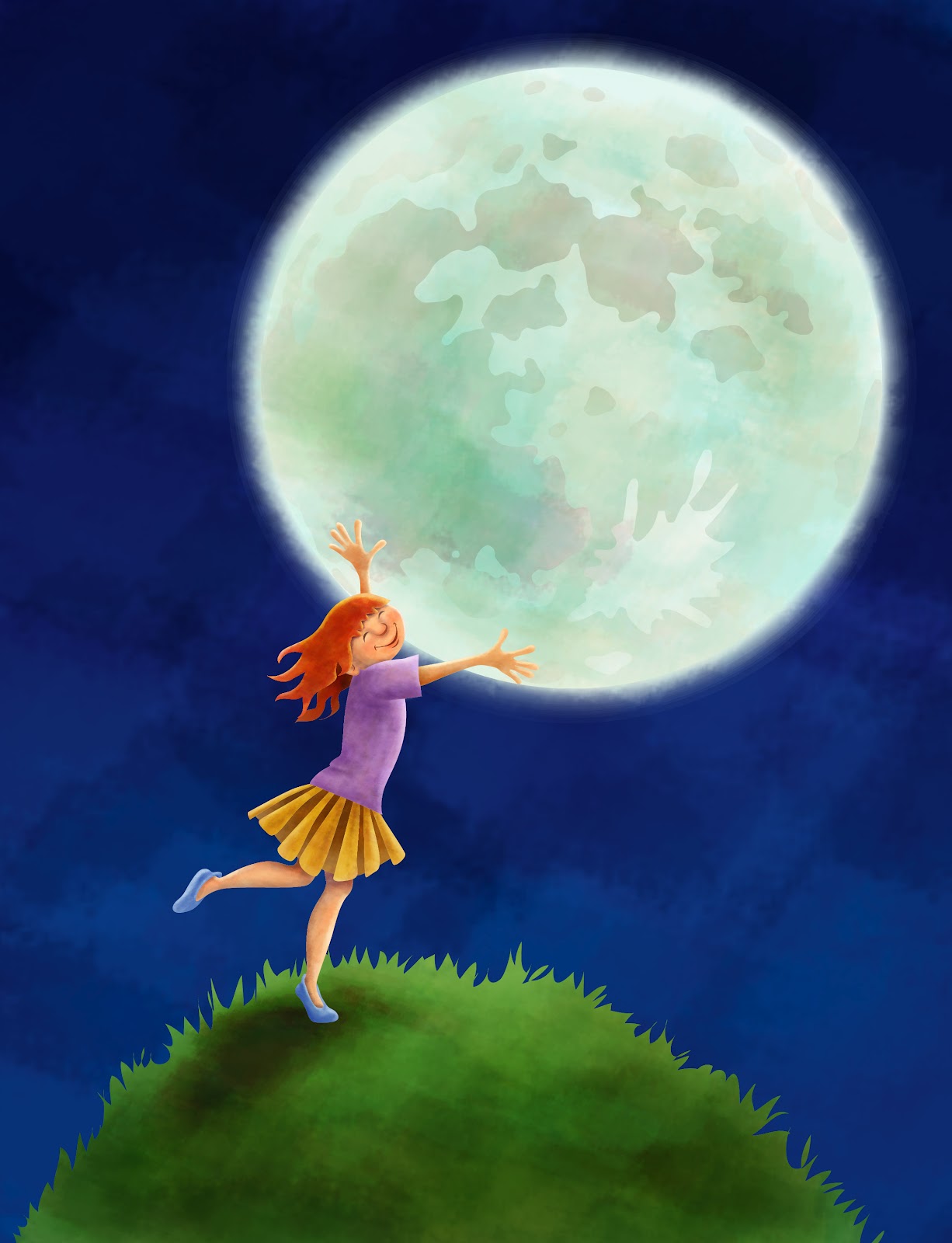
Moon Hug • Digital

 The moon's an arrant thief,
And her pale fire she snatches from the sun.
- William Shakespeare

This past Saturday saw the full moon reach perigee and look 14 percent larger than other full moons throughout the year, earning it the term Supermoon. Unfortunately, it was cloudy that night in my area, and I was left to create a big moon of my own to enjoy, with little Agnes to give it a great big hug. 

Here's some additional loony fun stuff:

Chinese mooncakes are made for the Chinese New Year and an autumn harvest festival. A thin crust covers a rich filling made from red bean or lotus seed paste with an egg yolk in the middle. Many recipes are available online, from quickies that look nothing like this pretty picture to more accurate versions that still use more familiar ingredients.

The first children's book written by L. Frank Baum was a collection of stories based on nursery rhymes called Mother Goose in Prose. Each nursery rhyme was expanded to a longer narrative with more detail and character development. We find out how the old woman ended up living in a shoe, a situation which many modern parents can relate to. The black sheep has an interesting attitude towards the wool industry. And the Man in the Moon longs to be a part of the world below, only to find difficulties arising from unexpected contradictions. 

I loved this book and especially loved the marvelous illustrations by Maxfield Parrish, such as the one above of the Moon Man.

Dr. Eugene Shoemaker, to date, is the only human being for whom the moon is a final resting place. Some of his ashes were on board 1999's Lunar Prospector when it was deliberately crashed into the lunar surface after a mapping mission. Dr. Shoemaker was best known for discovering the comet Shoemaker-Levy 9 with his wife Caroline and David Levy. He founded and was the first director of the Astrogeology Research Program and was involved in training the Apollo astronauts.


Monday, April 30, 2012

Art and Baseball Day, Part Three: At The Ballpark

Citizen's Bank Park

Baseball is the hurrah game of the republic! 
That's beautiful: the hurrah game! 
Well - it's our game: that's a chief fact in connection with it: America's game.
- Walt Whitman


I belong to the Church of Baseball.

I'm not as zealous as Annie Savoy in Bull Durham; more of a enthusiastic supporter as much as time and finances will allow. Delaware has no MLB team of its own, so we "borrow" the neighbors' - Phillies or Orioles.

The Phillies have been on my altar since childhood. They were one of the few things besides DNA that my father and I had in common, until he converted to the Braves in later years, accentuating an already established chasm between us.

There were seasons when I would be glued to every game, and others where I was distracted by the usual life stuff that presented itself. Whenever I returned to baseball, it was always for the Phillies, a big city team with a loony, green mascot, and fans that made Attila the Hun's army look like pussycats.

My attention would ebb and fluctuate, even after their 2008 World Series win, until the 2010's Snowmaggedon. In the midst of storms and snowpiles that seemed never to end, I dreamt of spring and all that came with it, including sun, gardens, and baseball.

I had never paid so much attention to Spring Training before, but while buried in drifts of frozen white, I became obsessed. Baseball represented everything that winter was not. It was green. It was warm. It was joyous outside playtime. And I began to appreciate it in a way I never had before. Football never held any glamour for me, and seemed a cold, violent sport. So, at the end of each season, I now begin the countdown to the days when our boys travel to Clearwater, Florida to begin their preparations.

On Art and Baseball Day, after a luxurious dip in the Philadelphia Museum's collection, I drove down to the sociological ecosystem with the dismal name of Citizens' Bank Park. That's what it will be called until the next corporate takeover. If only we could go back to naming sports complexes in honor of dead people who don't try to buy out one another.

Having not been to a pro game in many years, I discovered two things. One, not surprisingly, the food is overpriced garbage and you eat it anyway. Fortunately for me, they had vegetarian-friendly overpriced garbage in the form of vegan hot dogs.

Two, I could not stay seated. Normally, I watch a game while pumping away on my elliptical, burning extra calories after home runs. I felt claustrophic and fidgety in the stands. Although, I carry around a few unwanted pounds, I'm not nearly as hefty as some other spectators who easily had a least 100 pounds on me and still sat squished in the little plastic seats. It was much more relaxing to walk around, partaking of the occasional fat-laden munchie, and watching the game from the rails.

They lost fabulously. Went down in flames. Got smacked home to Mama. It was well enough into the season to not be too surprised. This year so far, the Phillies are inspiring more tears than cheers. Those seasons happen every so often. But, being in a baseball park, I learned, is not strictly about the team. It's a social occasion, filled with mingling, eating, and enjoying fresh air.

While observing the crowds, I was reminded of a painting I had stood in front of earlier that afternoon: Toulouse-Lautrec's At The Moulin Rouge: The Dance. Like the baseball fans who milled around the stands and alleys, the painting's subjects were also people from all walks of life gathered at a popular social watering hole.

This was our Moulin Rouge, I thought, standing patiently in the ice cream line, while waves of bodies traveled back and forth like blood cells coursing through an artery. At night, the similarity would be even more apparent, under the glow of artificial light. Even though at the ballpark there are kids instead of prostitutes, Henri might still have enjoyed it.

I'll be returning later in the season, whether the team finds their game or not, to observe, enjoy, eat like a pig, yell "Hit something!" and absorb the last vestiges of Summer before the cold starts creeping in again.

Monday, April 23, 2012

Art and Baseball Day, Part Two: Scribbling Away at the Museum

Sketch of Virgin & Child, 1646, Jose Jusepe de Ribera
In case you hadn't noticed, I love to scribble.

The other, more refined term would be to sketch. Scribbling is what I call grabbing a pencil, pen, crayon, lump of coal or any other implement of creation and attacking a handy surface (usually paper) with it. Scribbling is the sound made by such an endeavor, when all other sounds fall away and shapes, curves and textures come to life at your hand.

After visiting the Van Gogh Up Close exhibit at the Philadelphia Museum, I inhaled some lunch, then set out to explore the countless rooms, hallways, nooks and crannies of the vast collection. If I saw something that caught my eye, out came the drawing pad and pencil, ready to take down pictorial dictation of a celebrated work.

It's amazing what you discover about a painting by copying its forms in simple graphite. Breaking it into shapes and tones, you see patterns that reveal themselves only after the intense scrutiny necessary for duplication.

I was drawn to Spanish Baroque painter Jose Jusepe de Ribera's Virgin and Child for its earthy depiction of the Holy Mother and little Christ. While working, I wondered about the models used, who they were and how they became the actors in this scene. Aside from the bright blue of the shawl and the angelic expressions, this could've been a sweet family portrait of any mother and baby.

Sketch of Young Boy
with Toy Soldiers
,
1876, Antonio Mancini
The face of the Young Boy with Toy Soldiers by Antonio Mancini intrigued me. The composition of the piece looked like that of a photograph spontaneously taken while he played. Although frilly collars and over 130 years separate the subject from any kid today engrossed in his games, the unaffected expression of youth surely hasn't changed much.


Guan Yin, 960-1279, Song Dynasty
What a delight to turn a corner into a darkened Asian temple to find Guan Yin, the enlightened figure in the Buddhist tradition associated with compassion.
I always loved the way she sits, as she is often portrayed in this position, chilling out, ever so mellow and calm. One of my favorite stories about her is when she was executed for not entering an arranged marriage and was sent to a helllish realm, her love, compassion and grace threatened to turn it into a paradise, and she was summarily kicked out. It's been said by modern thought teachers that we are each responsible for the energy we bring into a situation. The legends of Guan Yin certainly illustrate that the lesson is not a new one.

There were other sketches done during that afternoon, favorite paintings revisited as well as new discoveries. During my years in Philly while attending UArts, I regret not spending more time at the Museum while I had easier access. As I left to go to Citizens' Bank Park for the Phillies' encounter with the Mets, I made a quiet pledge to come again later this year, and also take advantage of the close proximity of smaller museums around Delaware.

Sunday, April 15, 2012

Art and Baseball Day, Part One: A Visit with Vincent

Two Cut Sunflowers - Vincent Van Gogh • vangoghgallery.com

Working distracts me infinitely better than anything else. 
And if I could once really throw myself into it with all my energy, 
that might possibly be the remedy.
-Vincent Van Gogh

On a carefully planned April day of Art and Baseball in the big city, I had an opportunity to attend the Philadelphia Museum of Art's exhibition, Van Gogh Up Close. A feast for the eyes doesn't begin to describe it. The image above is a poor reproduction of the original painting, which is composed of chunky, luminous brushstrokes that tempts you to run your fingers over them.

How Van Gogh depicted the arrangement of seeds inside the sunflower through the subtlest of markings amazed me, and it's something you can only appreciate standing in front of the painting itself, close enough to take in the detail, but not so close the museum guard yanks you back like a hooked trout.

Rain - Vincent Van Gogh • philamuseum.org

From outside of his room at the Saint-Paul clinic, Van Gogh was able to capture a field bombarded by a passing storm despite the bars covering his bedroom window. What impressed me most about this piece was that it really looks like a storm. So many storm paintings attempt to bring power to the clouds and water with color and contrast, making them too bright. The above image is an accurate portrayal of a dreary day where you can almost hear the rumble of thunder and the constant pattering of raindrops on the ground and the building. You can even make out the accumulation of water into glistening puddles.

The exhibit was a further reminder that no matter how good a print job or digital capture is done, you cannot experience a painting fully, with all its personality and imperfections, unless you meet it in person. There are colors that can never be conveyed by anything other than the human eye.

So many other paintings called to me in the exhibition rooms. I did what I usually do: wandered around like a lost drunk, gazing at some for several minutes, then running back to others that had stuck in my mind. I tried to exit several times, only to be stopped by the urge to make another round, all the while sending my love and gratitude to the artist.

After making it out the exit, I was immediately bombarded by the commercial inspiration of Van Gogh's work through the vast variety of overpriced items in the gift shop. Prints, bags, umbrellas, games, shirts, scarves, mugs, magnets, and so on. What do you think, Vinny? Thousands of dollars gleaned from paintings that people in your lifetime didn't give a damn about. You only sold one painting. These folks are making a fortune. The most painful offerings were the holographic bookmarks. Gag. That being said, a magnet of Two Cut Sunflowers graces my refrigerator, and the accompanying coffee table book for the show lies on my ottoman.

An art teacher of mine once told of how someone had said that an artist must suffer in order to create. My teacher had scoffed at this, only to change his mind later on. I, too, did not embrace the notion that pain was necessary for an artist. It seemed like a dismal future for anyone who embraced a creative career. But, the years have taught me different.

When we create, we enter a new world, away from the one that is the source of the pain. For a little while, the brushstrokes, or chords, or words, or whatever becomes the reason to exist. The relationship to the medium is the only one that matters, and it's a relationship that gives far more comfort, sometimes, than those with the situations and people in our lives. Van Gogh seemed to feel that keenly, as suggested by the above quote.

If the universe gave us the pain of our self-awareness, it was at least thoughtful enough to also give us a wonderful form of escape that can still be shared with others.